
Your choice regarding cookies: We use cookies when you use this Website. These may be 'session' cookies, meaning they delete themselves when you leave the Website, or 'persistent' cookies which do not delete themselves and help us recognize you when you return so we can provide a tailored service. However, you can block our usage by adjusting your browser settings to refuse cookies.

SUMMARY
- We view Kevin Warsh as a credible choice for Fed Chair.
- Software companies’ shares have struggled as AI upstarts gain traction.
- We continue to favor technology-related themes, but prefer hardware to SaaS software.
The past week or so, the market has had a lot of news to absorb. President Trump’s appointment of Kevin Warsh to Fed Chair sparked volatility in the US dollar, rates, and precious metals. In addition, a rash of technology-related news caused a large selloff in software and broader tech shares. Today we sift through this tumult and share our views on where the market may be headed.
Kevin Warsh: Experienced, Pragmatic and Pro-Growth
While Warsh’s appointment still needs to be confirmed by the Senate, we expect him to survive confirmation. Warsh is not an unknown to the market, having previously served as a Fed Governor from 2006-2011 as well as a professional investor at prominent firms like Morgan Stanley and Duquesne. His experience in helping successfully restructure the banking system during the Great Financial Crisis suggests pragmatism, a cool head in crises, and a deep understanding of the US financial system…all positive traits for a Fed Chair. In summary, he is:
- An experienced practitioner who is savvy to the intricacy of the US financial system and markets
- An outspoken critic of the Fed’s past reliance on quantitative easing and balance sheet expansion, as well as their tendency to ‘overcommunicate’ to the public
- An eloquent champion of pro-growth fiscal and monetary policy and less corporate regulation – in that way, he is a good fit for the Trump Administration, in our view
- A believer – as are we – that the effects of artificial intelligence are generally productivity-enhancing and disinflationary
- Aligned with Treasury Secretary Scott Bessent in views, background, and shared experience: Warsh has expressed that Treasury and the Fed should coordinate policy, keeping the Fed focused simply on monetary policy
The bottom line is that we view Warsh as a credible choice for Fed Chair, who is likely to be pro-growth, shake up the status quo regarding policy choices and communication, yet respect the independence and apolitical nature of the office. While the US dollar, bond yields and precious metal prices were initially volatile in the wake of his announcement, we think markets will eventually accommodate his influence. We don’t view Warsh’s appointment as a reason to change our overall constructive view of US markets. In addition, we suspect that the global rotation into value and cyclical stocks – in place well before Warsh was appointed – may continue in light of his policies.
Tech Spending and the Anthropic Announcement – What to Make of the ‘SaaSpocalypse’
New AI companies threaten traditional software incumbents. Software-as-a-service (SaaS) is a business term for buying software as a regular subscription rather than as a one-time installed product. It is how most software is now delivered, and is a better model for software companies as it provides a regular stream of income. 2026 has witnessed an ongoing bout of selling pressure in SaaS stocks – aka the ‘SaaSpocalypse’ - as investors assess how newly-released AI models might replace existing software. This week the private company Anthropic did just that by announcing an upgrade to its Cowork AI assistant, which has the potential to replace existing software in areas like financial and legal analysis.
Big earnings, big spending. While the most acute selling has so far been confined to software companies, technology shares’ performance in general in ‘26 has also suffered from increasing concerns over an AI spending ‘bubble.’ Bellwethers such as Alphabet (Google) and Microsoft beat earnings estimates last week, but also guided the Street to higher-than-expected capex, which marred otherwise strong earnings announcements. According to a recent MSN article, the four largest tech companies are likely to spend approximately $650bn on AI infrastructure this year alone. For the major technology companies who are spending so much to build the AI infrastructure and develop products, the key is whether they ultimately get a good return on that investment. The uncertainty of that answer is what is creating the volatility in their share prices. In general, we are optimistic on mega-cap tech, but acknowledge that this is a hotly debated issue on Wall St. and Main St. alike. We would make two important points here:
- AI creates winners and losers – we prefer hardware over software: We have written a lot about the macro and micro effects of AI on markets – one thing that is clear to us is that AI is a disruptive technology that will create clear winners and losers at the company and industry level, even as it creates broad productivity and economic growth across the US economy. Late last year, we wrote about the ‘AI Gold Rush,’ and broke AI business models down into those spending to build infrastructure, those developing new products and those benefiting from the spending buildout. For now, we believe semiconductor companies are the big winners from all the spending – and it remains to be seen whose products will ‘win’ the AI race.
Chart 1: Tech Cash Flow Remains Superior
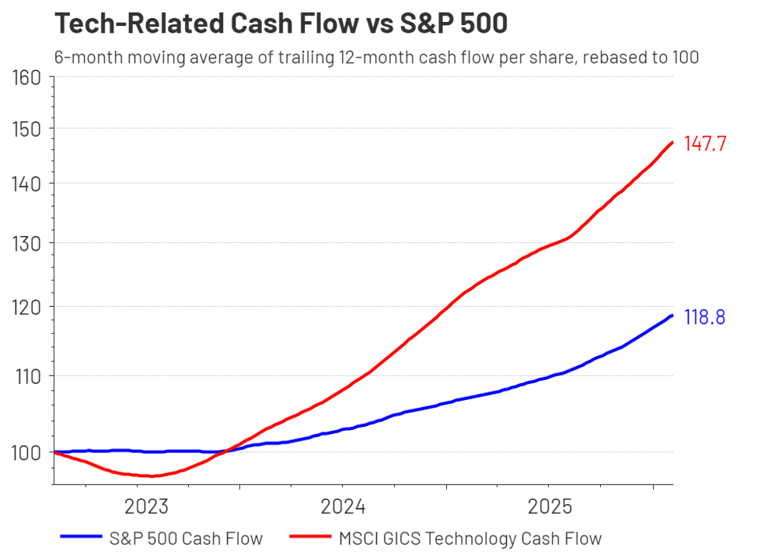
- The tech sector as a whole is still a winner: We view concerns of a significant slowdown in AI spending as unlikely in 2026 while maintaining a preference for AI ‘picks and shovels’ providers over smaller AI model provider ‘miners’. We believe this preference continues to be justified by recent earnings and cash flow results – mega-cap technology cash flows have well outpaced the broader S&P 500 over the last three years (Chart 1, above). When looking at our current portfolio positioning, all our portfolios are overweight hardware relative to their benchmarks, with individual stock positions in each of these segments where our models allow it. Additionally, we have broad exposure to physical infrastructure through thematic ETFs in our longer horizon portfolios.
Conclusion: Recent Volatility Unlikely to Persist, in Our View
As we recently discussed in our January 21st ‘Three Rules’ update, the market has entered the new year with a strong trend but highly optimistic crowd sentiment…suggesting a potential near-term pause in the market uptrend. The recent volatility over the Warsh appointment and software’s struggles may be the beginning of such a pause. As always, the difficulty for a tactical investor is determining which market corrections will be deep and prolonged enough to try and successfully time, especially as both the trend and macro fundamentals continue to suggest to us a positive market stance. Our current view is that the current volatility will likely be too brief and shallow to be able to successfully avoid without ‘whipsawing’ investors, ala last April’s ‘Liberation Day’ meltdown (and dramatic subsequent rebound). Nonetheless, we are closely monitoring both fundamental and technical indicators for any degradation that may cause us to become more tactically cautious.
Risk Discussion: All investments in securities, including the strategies discussed above, include a risk of loss of principal (invested amount) and any profits that have not been realized. Markets fluctuate substantially over time, and have experienced increased volatility in recent years due to global and domestic economic events. Performance of any investment is not guaranteed. In a rising interest rate environment, the value of fixed-income securities generally declines. Diversification does not guarantee a profit or protect against a loss. Investments in international and emerging markets securities include exposure to risks such as currency fluctuations, foreign taxes and regulations, and the potential for illiquid markets and political instability. Please see the end of this publication for more disclosures.
Download 02.10.2026 | Weekly View
Authored by
-

Chris Konstantinos CFA®
Managing Partner | Chief Investment Strategist