
Your choice regarding cookies: We use cookies when you use this Website. These may be 'session' cookies, meaning they delete themselves when you leave the Website, or 'persistent' cookies which do not delete themselves and help us recognize you when you return so we can provide a tailored service. However, you can block our usage by adjusting your browser settings to refuse cookies.

SUMMARY
- The Fed is on the investor’s side as it has lowered rates and is fighting to maintain independence, in our view.
- The Trend remains positive but approaching unsustainable levels.
- The Crowd has become too optimistic, in our opinion.
Since the last update of our ‘Three Tactical Rules’ on November 4th, equity markets have continued to grind higher, as the S&P 500 is now less than 100 points away from reaching 7000. Ironically, the S&P’s march higher has occurred despite a government shutdown that distorted the economic data and left financial markets with just as many questions as it answered.
As we turn to preview the Three Rules (‘Don’t Fight the Fed’, ’Don’t Fight the Trend,’ and ‘Beware of the Crowd at Extremes’), the Fed continues to prioritize employment over inflation in the short term. Since our last update, the Fed has lowered interest rates by an additional 25 basis points. We believe this means monetary policy remains on the equity investor’s side, via easing financial conditions. After rising nearly 10 percentage points since our last update, the Trend is positive but is approaching levels we deem unsustainable. With the Fed lowering rates and the Trend building momentum, the Crowd is more extremely optimistic, in our opinion. These extremes have resulted in a rating downgrade to our Three Rules, from a ‘flashing green light’ to a more neutral ‘flashing yellow light.’
‘Don’t Fight the Fed’: Lowering Rates and Fighting for Independence - GREEN LIGHT
The Fed lowered rates for a third time at its December 10th meeting, bringing the fed funds range to 3.50 – 3.75%, and the effective fed funds rate to 3.64%. Based on the median dot plot, the FOMC is only expecting one rate cut in each of the next two years. Furthermore, it continues to see 3.0% as the long-term neutral rate: the rate that neither stimulates nor contracts the economy. Currently, the Fed believes that its cumulative 75 basis points of cuts over the last 4 months will allow the labor market to stabilize, while giving inflation time to move towards its 2% target after tariff impacts.
We continue to believe that the Fed may have been too worried about the labor market, and too laissez-faire regarding inflation. We view the labor market as now normalizing, given the changing demographic and hiring landscape in the US. However, the Fed believes that there are major distortions in the data that are subject to large downward revisions, prompting its pre-emptive cutting of rates. In addition to cutting rates, the Fed is also stimulating the economy with T-Bill purchases of $40 billion, which should increase liquidity. This additional cash could find its way into purchases of risky assets.
While the Fed is on the investor’s side from a monetary policy perspective, it is also helping investors by fighting to maintain its independence. The defiant response of Chairman Powell after being subpoenaed has shown investors that the Fed is not going to cave to political pressure in setting monetary policy. Additionally, the bipartisan support of the Fed has also helped to keep investors calm, reducing volatility in both the stock and bond markets this time around. The Fed’s focus is on satisfying its dual mandate of full employment and price stability, as well as maintaining its independence, all of which benefit investors. Therefore, we believe the Fed continues to be on the investor’s side. We maintain our rating of a ‘green light’ on Fed policy.
Internationally, the Bank of England (BOE) has been gradually lowering rates as it tries to normalize its policy rate. The BOE last lowered rates by 25 basis points at its December 18th meeting to 3.75% after pausing in September. The BOE is expected to continue its measured approach, as the interest rate swaps market does not expect another cut until mid-year. Meanwhile, the European Central Bank (ECB) is also expected to hold its deposit rate steady throughout 2026. With inflation near its 2% target, the central bank is comfortable holding rates steady in our opinion. While the speed of monetary policy easing is different at each of the major central banks, we believe all are aligned with our ‘Don’t Fight the Fed’ mantra and are thus on the investor’s side. The Bank of Japan (BOJ) may be the one exception, as it is currently raising interest rates after leaving them artificially low for an extended period.
‘Don’t Fight the Trend’: The US Trend is Rising Quickly, Approaching Unsustainable Levels - YELLOW LIGHT
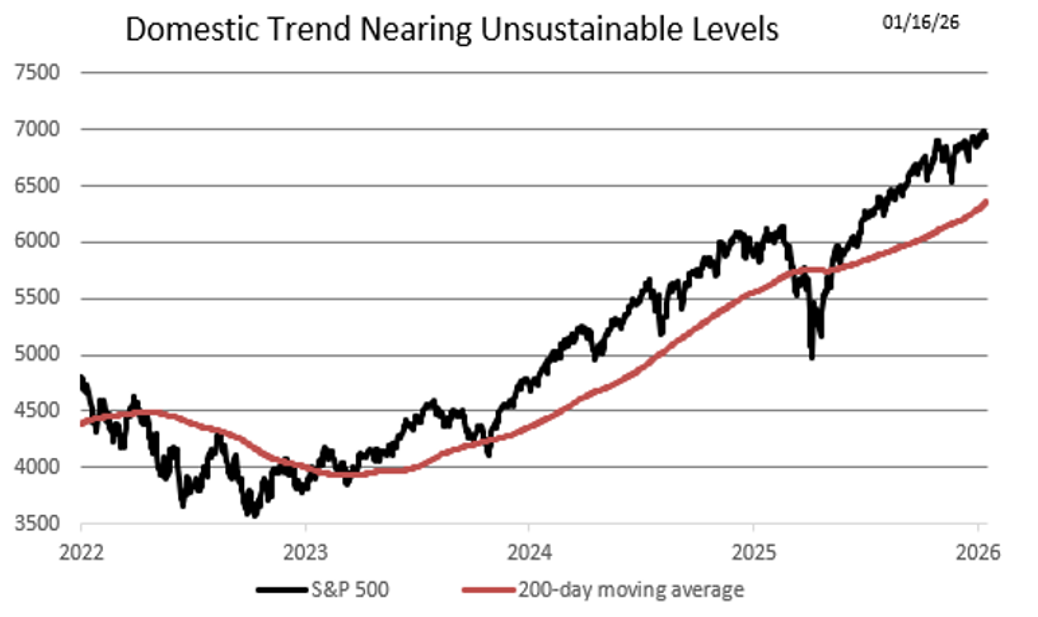
The trend on the S&P 500, which we define as the 200-day moving average, has continued to move higher over the last ten weeks. Since our last update, the index has risen by nearly 100 points and in the process set a new all-time high on January 12th. Since our last update, the materials, industrials, and consumer staples sectors have been the driving force behind the index’s move higher, as technology cooled into the end of 2025.
Currently, the trend is rising at a 28% annualized rate. Given that we are now right at ~200 days away from the April 7th low from last year, we believe the trend will likely accelerate above the 30% annualized rate in about 10 days if the index stays at current levels (as older data drops out of the average). The technical moving stop that we employed last summer using the 23% retracement from the April 7th low rose 50 points since our last update and now sits at 6478. Hence, the positive trend gives us the confidence to continue to hold US equities. We recognize that the trend is rising quickly and is approaching levels we do not feel are sustainable, but the odds of having a positive return are still on the investor’s side when viewing the ‘Three Rules’ through our quantitative lens. Thus, we are only downgrading the Trend from a ‘green light’ to a ‘yellow light.’
International Trend: Accelerating Back Towards Unsustainable Levels - YELLOW LIGHT
Internationally, the trend of the MSCI All Country World ex-US index (ACWX) has slowed over the last 10 weeks. The run rate of the primary trend is currently rising at a 29% annualized rate, compared to a 33% annualized rate in our previous update. During this period international equities outperformed domestic equities by roughly 460 basis points. Like the S&P, the ACWX index is also experiencing the impact of the April 7th ‘Liberation Day’ market meltdown rolling out of the data and thus pushing the average higher.
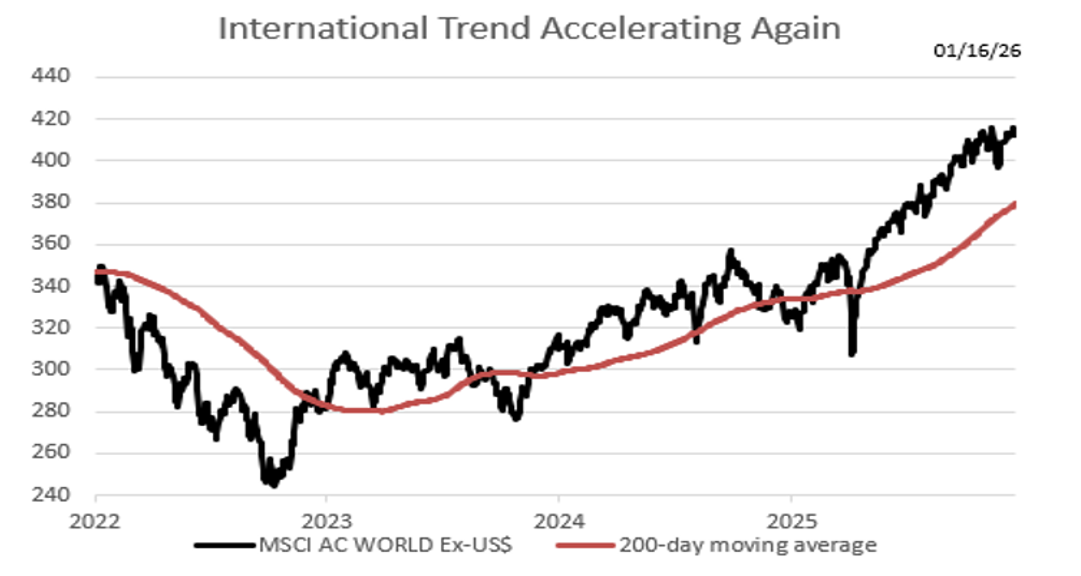
The international trend will soon accelerate at a pace north of a 30% annualized pace, which we deem too strong to be sustainable. Our tactical work has shown that a positive trend increases the odds of a positive return over the next three to six months. However, when the trend gets too high, the odds no longer improve. We fear that we could reach that inflection point in the coming weeks. However, for now the international trend’s current level is positive enough to warrant an upgrade to a ‘yellow light’ from a ‘flashing red light’ in our last update.
Beware of the Crowd at Extremes: Excessively Optimistic Sentiment Beginning to Impact Expected Returns - FLASHING RED
We regard Crowd Sentiment as the ‘contrary’ indicator of the Three Tactical Rules. The chart below shows a measure of investor sentiment as calculated by Ned Davis Research (NDR). When the line is high it shows excessive optimism, and when it is low, extreme pessimism. NDR research suggests that historically, extreme pessimism can create attractive entry points for tactical investors. This is our preferred data source to measure investor psychology, though we use our own analytical framework from which to draw conclusions on sentiment.
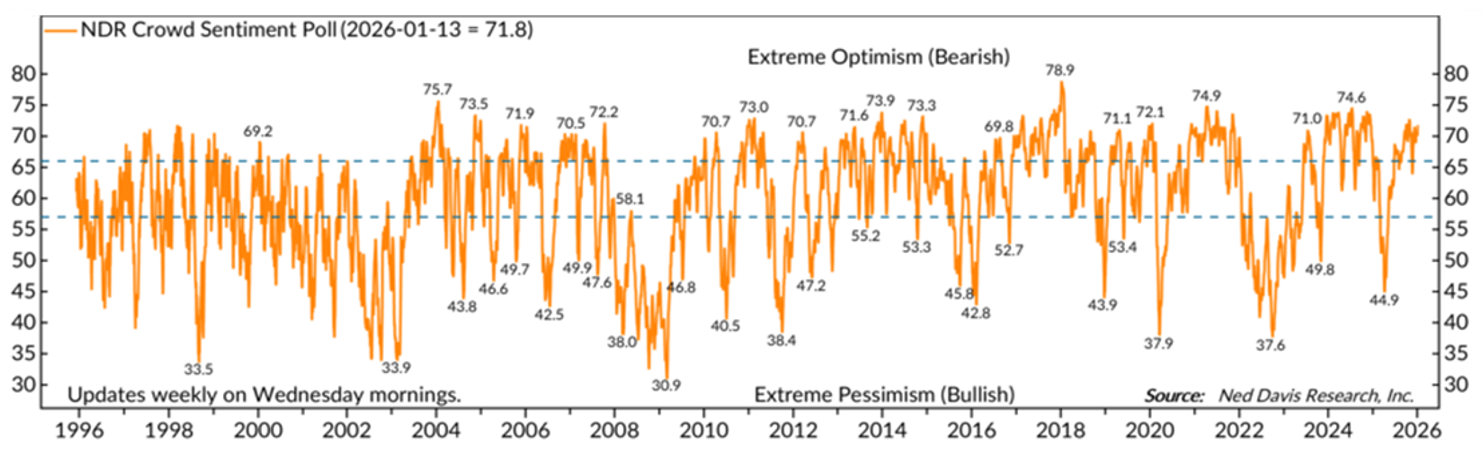
Currently, the NDR Daily Sentiment and the NDR Weekly Sentiment Polls are giving slightly different signals. Daily sentiment is at the top of the neutral zone, while weekly sentiment is starting to move into the upper end of the excessive optimism zone. The current condition is a deterioration in sentiment since our last update. Historically, we have given more weight to the Weekly for this publication, despite incorporating both measures of sentiment in our overall rating. The Daily tends to be a good indicator of the investor’s ‘real time’ view of financial markets, while the Weekly gives longer term perspective of the Crowd.
Given the current levels of the polls, we believe that the Crowd has become a bit too optimistic; the Weekly poll is nearing extraordinarily high levels within the extreme optimism zone. Additionally, Daily sentiment has entered the lower end of extreme optimistic zone from the neutral zone, thus eliminating the buffer that has allowed our Crowd rating to remain neutral with a “yellow light” over the last couple updates. The Crowd is starting to signal caution regarding holding equities at current levels, in our opinion. Hence, we are downgrading our rating for the Crowd to a ‘flashing red light’ from a ‘yellow light.’
Conclusion: The Tactical Rules are Less Bullish for Domestic Equities for Now - FLASHING YELLOW
The tactical rules signal a “flashing yellow light” after the Fed’s pre-emptive steps to lower rates, as it waits for the economic data to normalize post the October government shutdown. The good news for investors is that the Fed has eased financial conditions in the short term. Additionally, the trend remains strong and is currently the investor’s friend, but continued strength could cap expected returns over the next 3 to 6 months if the index continues to move higher at a rapid pace.
However, it is the contrarian indicator - the Crowd - which has caused the Three Rules to take a more cautious approach towards equity exposure overall, as both sentiment indicators are in the extreme optimism zone. Hence, our Tactical Rules are giving us a generally less bullish signal than at our last update. Over the next 3 to 6 months, we believe that market conditions still favor domestic and international equities over bonds but require investors to be more discerning as stock selection will be more important than simple broad market exposure.
Risk Discussion: All investments in securities, including the strategies discussed above, include a risk of loss of principal (invested amount) and any profits that have not been realized. Markets fluctuate substantially over time, and have experienced increased volatility in recent years due to global and domestic economic events. Performance of any investment is not guaranteed. In a rising interest rate environment, the value of fixed-income securities generally declines. Diversification does not guarantee a profit or protect against a loss. Investments in international and emerging markets securities include exposure to risks such as currency fluctuations, foreign taxes and regulations, and the potential for illiquid markets and political instability. Please see the end of this publication for more disclosures.
Download 01.21.2026 | Weekly View
Authored by
-

Kevin Nicholson CFA®
Global Fixed Income CIO | Partner