
Your choice regarding cookies: We use cookies when you use this Website. These may be 'session' cookies, meaning they delete themselves when you leave the Website, or 'persistent' cookies which do not delete themselves and help us recognize you when you return so we can provide a tailored service. However, you can block our usage by adjusting your browser settings to refuse cookies.

SUMMARY
- The Fed is on the investor’s side as it pivots to fight inflation.
- The US Trend remains positive but slows to a more sustainable level.
- The Crowd is neutral, enhancing our ability to hold equities, in our opinion.

Since the last update of our Three Tactical Rules on January 21st, equity markets have moved sideways, as the S&P 500 continues to attempt to break above the elusive 7000 milestone. The S&P has been rangebound largely due to angst around the hyperscalers’ AI spending plans and less certainty of Fed rate cuts. These headwinds have made it difficult for the index to continue to appreciate further after rallying nearly 40% since the April 2025 low. Our Three Tactical Rules of ‘Don’t Fight the Fed,’ ‘Don’t Fight the Trend,’ and ‘Beware of the Crowd at Extremes’ have each undergone changes during this period, some more visible than others.
As we turn to preview the three ‘Tactical Rules’, the Fed has begun to pivot away from its laser-focused prioritization of employment, turning instead to fighting inflation. The Trend that was rising at a pace deemed unsustainable during our last update has now peaked and is starting to decelerate to a more sustainable level, improving our overall tactical rating. Lastly, the Crowd has tempered its enthusiasm, which in turn has helped it be additive to our tactical rating. The cumulative changes of the Three Rules prompted our ratings reversal from a ‘flashing yellow light’ to a ‘flashing green light;’ the rating previously held prior to our last update.
‘Don’t Fight the Fed’: Pivoting to Fighting Inflation - GREEN LIGHT
The Fed held rates steady at its January 28th meeting. Currently, the fed funds target range is 3.50 – 3.75%, and the effective fed funds rate to 3.64%. At its latest meeting, the Fed cited stabilization of the unemployment rate and solid economic growth as reasons for holding rates steady. Furthermore, the committee stated that monetary policy was appropriately positioned to manage its dual mandate, as upside risks to inflation and the downside risks to labor had diminished. Subsequently, recent employment data has come in stronger than expected, as the unemployment rate fell to 4.3%. The better-than-expected unemployment data has prompted Federal Open Market Committee (FOMC) members to focus more on fighting inflation.
Looking through the Fed’s preferred inflation lens of core PCE, inflation remains elevated at 3%. Hence, the renewed focus on inflation as the labor side of the ledger has improved. The pivot in focus by the FOMC since our last update has caused forecasters to push back expectations for rate cuts to resume in the second half of the year. Currently, the fed funds futures market is predicting the FOMC to cut rates twice in 2026. However, the strength of the US economy, as shown by the Atlanta Fed’s Q1 GDP growth forecast of 3.0% quarter-over- quarter, will short circuit these plans, in our opinion. We believe that if core PCE remains elevated, there is a possibility that the Fed will pursue fewer cuts. Therefore, we believe the Fed continues to be on the investor’s side. We maintain our rating of a ‘green light’ on Fed policy.
Internationally, the Bank of England (BOE) has been gradually lowering rates as it tries to normalize its policy rate. Like the Fed, the BOE left rates unchanged at its last meeting as well. The central bank held its policy rate at 3.75% at its February 5th meeting. The BOE is expected to continue its measured approach, as the interest rate swaps market does not expect another cut until mid-year. Meanwhile, the European Central Bank (ECB) is also expected to hold its deposit rate steady throughout 2026. With inflation near its 2% target, the central bank is comfortable holding rates steady, in our opinion. While the speed of monetary policy easing is different at each of the major central banks, we believe all are aligned with our ‘Don’t Fight the Fed’ mantra and are thus on the investor’s side. The Bank of Japan (BOJ) may be the one exception, as it is currently contemplating raising interest rates as upside inflation risk continues to increase.
‘Don’t Fight the Trend’: US Trend Slows to a More Sustainable Level - FLASHING GREEN
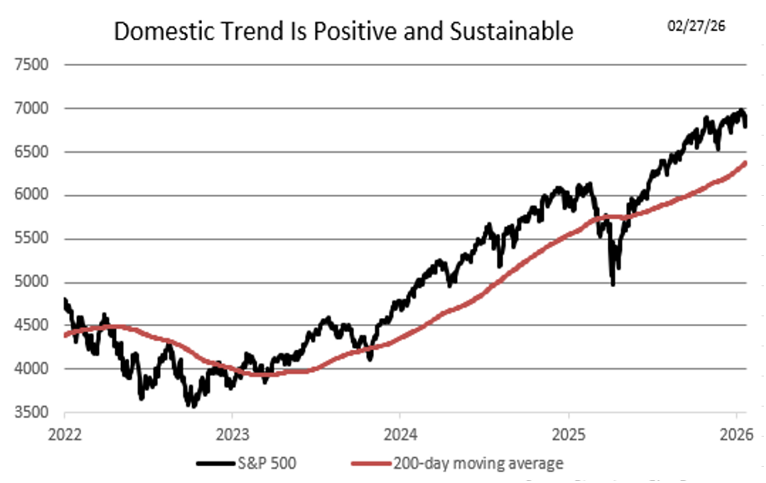
The primary trend on the S&P 500, which we define as the 200-day moving average (DMA), peaked over the last six weeks. Since our last update, the index has mostly traded sideways, only rising approximately 80 points and failing to break above 7000 as AI fears stalled the technology sector’s ascent. We believe this pause has helped the trend to slow down and return to a more sustainable level to facilitate positive returns over the next 3 to 6 months.
Currently, the trend is rising at a 31% annualized rate, but it will fall below 30% within the next week, in our opinion. Based on our previous research and experience, when the trend is rising between 20% and 30%, the S&P 500 has better-than-average odds of having a positive return over the next 3 to 6 months. While we are using history as our guide, we acknowledge that favorable odds don’t always guarantee success. However, we feel comfortable maintaining an overweight exposure to US stocks when the trend is positive. Currently, we view the domestic trend in a more positive light than in our previous update, given that it is now rising at a more sustainable rate. Thus, we are upgrading the Trend from a ‘yellow light’ to a ‘flashing green light.’
International Trend: Will Remain at Elevated Levels for Months - FLASHING RED
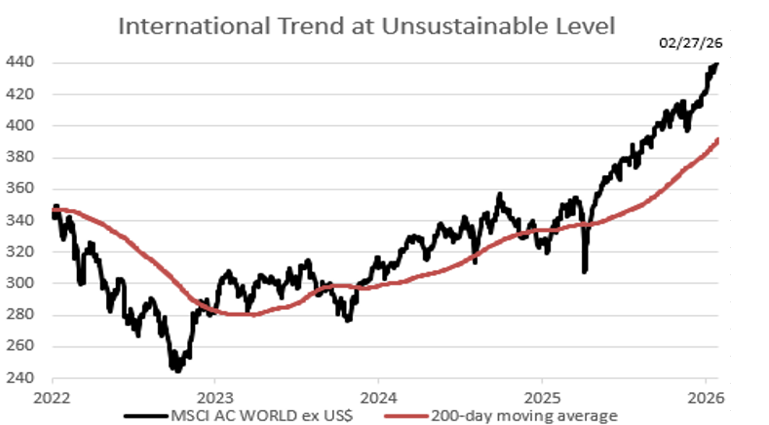
Internationally, the trend of the MSCI All Country World ex-US index (ACWX) has also peaked over the last 6 weeks. The run rate of the primary trend is currently rising at a 42% annualized rate, compared to a 45% annualized rate just two weeks ago. The strong international trend has led to international equities outperforming domestic equities by roughly 630 basis points since January 20th. However, the international trend currently is still running at a pace that we deem unsustainable.
If ACWX stays at its current level for the next month, we believe the trend will decelerate to a 34% annualized rate, which is closer to the 29% rate it registered in our last update. Our tactical work has shown that a positive trend increases the odds of a positive return over the next three to six months. However, when the trend gets too high, the odds no longer improve. This is the environment the international trend is currently experiencing. While we would applaud a slowing of the international trend to a more sustainable level, it is not going to happen overnight. Given that the international trend is predicted to remain above 30% for the next two months, we are downgrading it to a ‘flashing red light’ from a ‘yellow light’ in our last update.
Beware of the Crowd at Extremes: Poll Extremes Neutralize the Crowd - YELLOW LIGHT
We regard Crowd Sentiment as the ‘contrary’ indicator of the Three Tactical Rules. The chart below shows a measure of investor sentiment as calculated by Ned Davis Research (NDR). When the line is high it shows excessive optimism, and when it is low, extreme pessimism. NDR research suggests that historically, extreme pessimism can create attractive entry points for tactical investors. This is our preferred data source to measure investor psychology, though we use our own analytical framework from which to draw conclusions on sentiment.
Currently, the NDR Daily Sentiment and the NDR Weekly Sentiment Polls are giving opposite signals. Daily sentiment is at the top of the extreme pessimism zone, while weekly sentiment remains in the excessive optimism zone. The current condition is an improvement in sentiment since our last update. Historically, we have given more weight to the Weekly for this publication, despite incorporating both measures of sentiment in our overall rating. The Daily tends to be a good indicator of the investor’s ‘real time’ view of financial markets, while the Weekly gives longer term perspective of the Crowd.
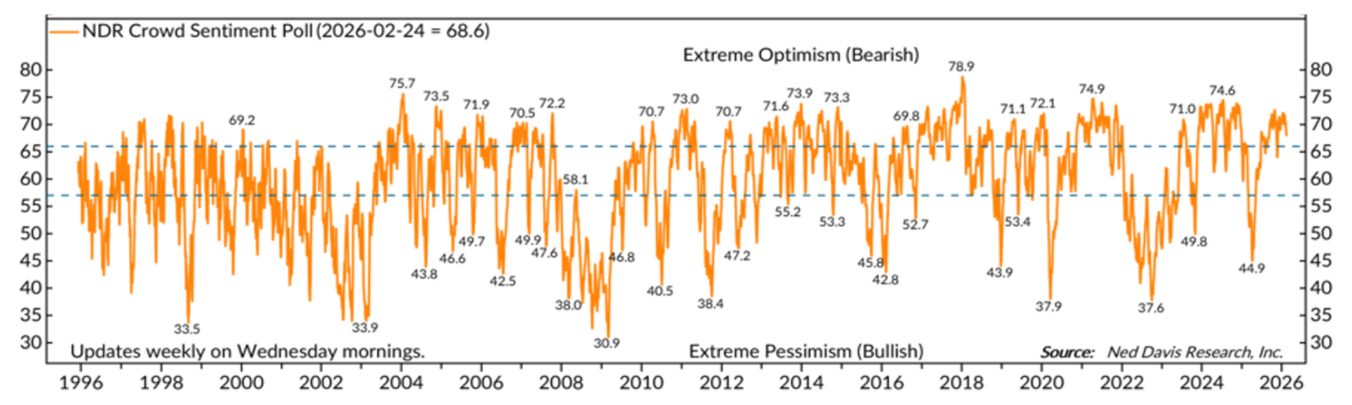
Given the current levels of the polls, we believe that the Crowd has become more neutral; the Weekly poll has fallen recently but still sits firmly in the middle of the extreme optimism zone. However, Daily sentiment has fallen from the neutral zone into the upper end of the extreme pessimism zone, thus creating mixed signals that would place our Crowd rating at neutral. At current levels, the shorter-term pessimistic crowd sentiment has made us more comfortable holding equities. Hence, we are upgrading our rating for the Crowd to a ‘yellow light’ from a ‘flashing red light’ in our previous update.
Conclusion: The Tactical Rules Are Bullish Preferring Stocks Over Bonds - FLASHING GREEN
The tactical rules signal a “a flashing green light” in the aftermath of the Fed holding rates steady, the Trend decelerating, and the Crowd being neutralized by sentiment polls that are viewing the market through different lenses. Given the fluidity of economic data, earnings guidance, and the mood of investors, the Three Rules are likely to move around further in the weeks to come. However, currently our Tactical Rules are giving a more bullish signal than our last update. Over the next 3 to 6 months, we believe that market conditions will continue to favor domestic and international equities over bonds as yields continue to fall.
Risk Discussion: All investments in securities, including the strategies discussed above, include a risk of loss of principal (invested amount) and any profits that have not been realized. Markets fluctuate substantially over time, and have experienced increased volatility in recent years due to global and domestic economic events. Performance of any investment is not guaranteed. In a rising interest rate environment, the value of fixed-income securities generally declines. Diversification does not guarantee a profit or protect against a loss. Investments in international and emerging markets securities include exposure to risks such as currency fluctuations, foreign taxes and regulations, and the potential for illiquid markets and political instability. Please see the end of this publication for more disclosures.
Download 03.03.2026 | Weekly View
Authored by
-

Kevin Nicholson CFA®
Global Fixed Income CIO | Partner