
Your choice regarding cookies: We use cookies when you use this Website. These may be 'session' cookies, meaning they delete themselves when you leave the Website, or 'persistent' cookies which do not delete themselves and help us recognize you when you return so we can provide a tailored service. However, you can block our usage by adjusting your browser settings to refuse cookies.

Summary
- Market leadership broadening beyond tech is healthy for the bull market.
- Earnings revisions ex-tech are turning uniformly positive for the first time in years.
- Pullbacks ahead are likely opportunities, not exits — stay the course.
For the better part of the last three years, the investment conversation has been dominated by a single theme: mega-cap technology. The "Magnificent 7" trade was real…and rewarding for those who stayed the course. But lack of market breadth also made many investors nervous…so much so that we addressed the issue directly back in 2023. A bull market where seven stocks do most of the heavy lifting is a bull market that depends heavily on those seven stocks continuing to deliver. But, as we stated back in 2023, ‘breadth itself is not a reason to be bearish”. Historically, narrow breadth just as often ends in a positive, not negative way – with broadening breadth refreshing risk appetite and ushering in the next phase of a bull market.
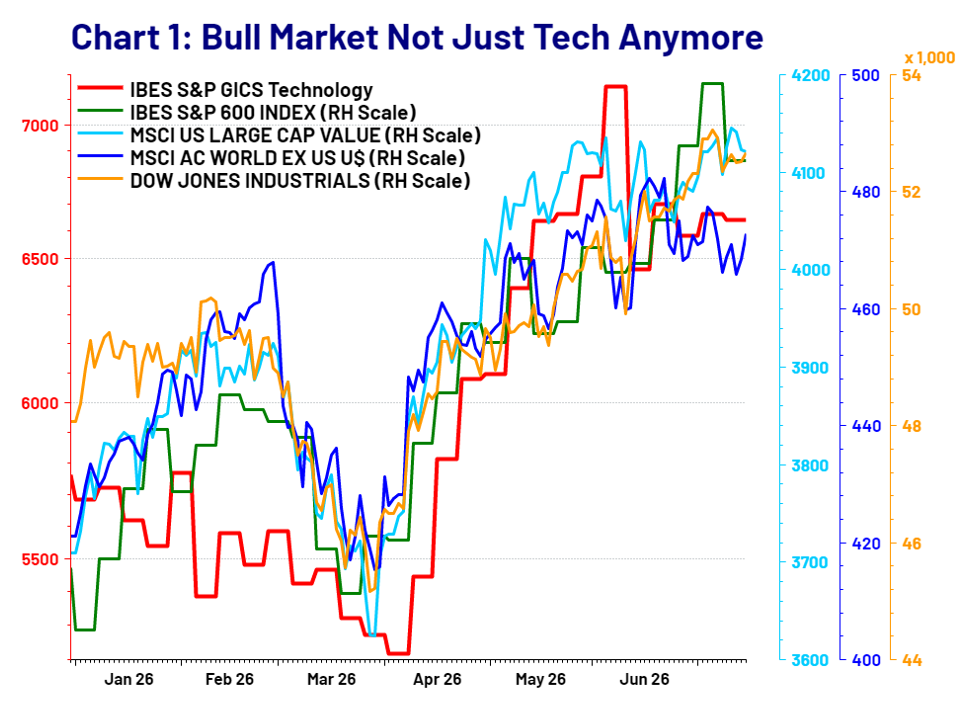
For those concerned about a narrow bull market, here's some good news: it appears to us that market leadership is now broadening to incorporate varied themes outside of just tech. New all-time highs in 2026 are no longer just a tech-dominated S&P 500 story: the S&P 600, the MSCI US Large-Cap Value Index, MSCI All-Country World ex-US index and the more cyclically-oriented Dow Jones Industrial Average (DJIA) have all joined the party in recent weeks, outperforming tech in the process (Chart 1 below). And in our view, that's a healthy turn of events for this bull market.
This kind of rotation reflects a market that is beginning to price in something broader than an AI-fueled tech boom — it's beginning to price in a genuine global corporate earnings expansion.
Earnings Momentum and Contained Inflation - the Catalyst Needed for Rotation to Continue
We've written about the "reflationary" economic backdrop before — an environment characterized by positive GDP growth, earnings expansion, and inflation that is higher than the Fed’s 2% target, but remains contained. This generally describes the current US economic backdrop…and is the kind of environment in which cyclical and value-oriented sectors in the US and internationally tend to do well.
Earnings revisions have been a major catalyst. The key development in recent months isn't just that tech earnings have remained strong — it's that revisions outside of tech have begun to firm up as well. Earnings revision ‘momentum’ - which we define as the percentage of analyst earnings estimates revised up, minus those revised down, over the total number of revisions - for all S&P 500 sectors is now positive for the first time in years (Chart 2 below). In particular, Financials (teal line) and cyclical business models such as Industrials (red line), Materials (gray line) and Energy (green line) have now joined Tech above the zero line. The same is also generally true in broad Europe, Japan and Emerging Market indices. When earnings breadth expands, market breadth tends to follow, in our view.
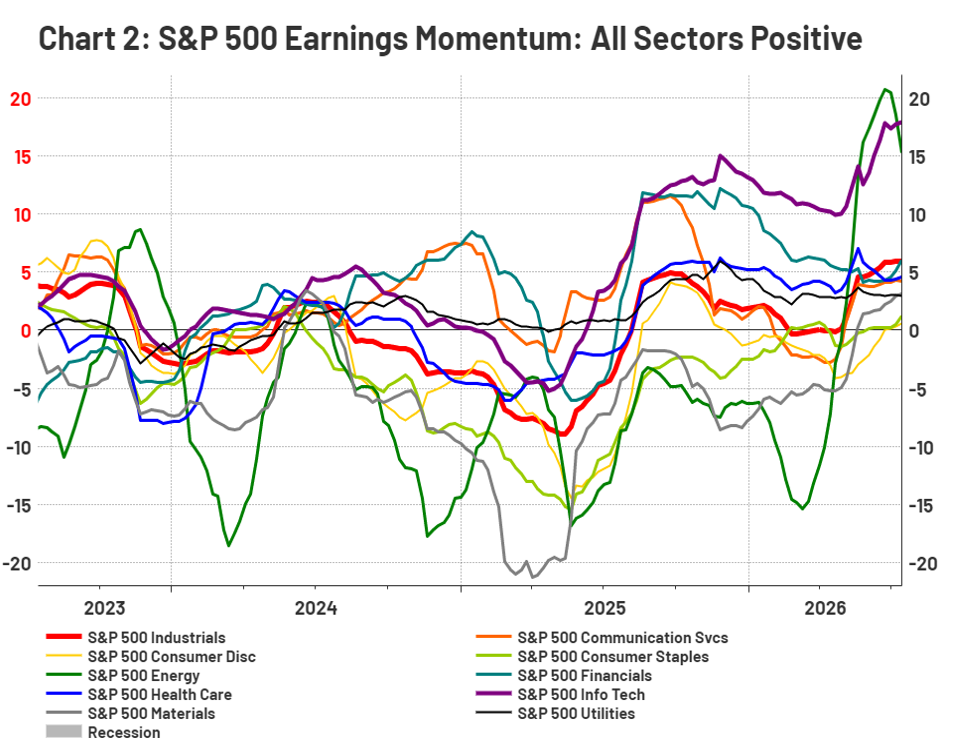
Note: this non-tech earnings momentum rotation is encouraging, but it is also early. A few things need to go right for it to have legs. Outside of tech, actual earnings and cash flow growth have improved, but still remain less strong overall …one reason we remain overweight certain tech themes, despite recent volatility and last week’s meaningful sell-off in semiconductors.
Second, inflation needs to stay in that "elevated but contained" zone. If the Iran uncertainty causes energy prices to re-accelerate, we could see an interest rate spike that disproportionately hurts rate-sensitive stocks, particularly smaller-caps and financials…as we have written about recently. However, we believe last week's softer-than-expected core CPI print of 2.6% year-over-year was an important positive data point for the reflation theme. It suggests to us that the underlying inflation trend ex-energy may be more benign than feared. That matters for our rotation thesis, because "inflation elevated but contained" is the sweet spot. It supports revenue growth for cyclical companies without forcing the Fed into a posture that chokes off the expansion.
Conclusion: We Remain Constructive on US and Global Stocks, Despite Near-Term Challenges
We remain constructively positioned and continue to favor stocks as our base case for the second half of 2026. However, we may be encountering some near-term headwinds for markets. In a mid-term election year, Q3 has historically been the most challenging quarter of the year. And as we recently noted, investor sentiment has moved to optimistic levels that warrant some humility. Elevated investor optimism is not a reason to exit, but it is a reason to stay disciplined. That said, we view any Q3 volatility through the lens of what we believe remains a fundamentally sound bull market. Pullbacks within a healthy expansion are generally opportunities, not times to exit. The bull market is growing up. It's learning to walk on multiple legs — and we think that makes it more durable, not less.
Risk Discussion: All investments in securities, including the strategies discussed above, include a risk of loss of principal (invested amount) and any profits that have not been realized. Markets fluctuate substantially over time, and have experienced increased volatility in recent years due to global and domestic economic events. Performance of any investment is not guaranteed. In a rising interest rate environment, the value of fixed-income securities generally declines. Diversification does not guarantee a profit or protect against a loss. Investments in international and emerging markets securities include exposure to risks such as currency fluctuations, foreign taxes and regulations, and the potential for illiquid markets and political instability. Please see the end of this publication for more disclosures.
Download 07.21.2026 | Weekly View
Authored by
-

Chris Konstantinos CFA®
Managing Partner | Chief Investment Strategist