
Your choice regarding cookies: We use cookies when you use this Website. These may be 'session' cookies, meaning they delete themselves when you leave the Website, or 'persistent' cookies which do not delete themselves and help us recognize you when you return so we can provide a tailored service. However, you can block our usage by adjusting your browser settings to refuse cookies.

SUMMARY
- US large-cap is on a level of its own.
- Value-oriented markets take a step back.
- Earnings have become even more important as global markets face uncertainty.
While the world focuses on the war in Iran, we would remind investors that corporate earnings trends are a more profound driver of stock prices over the intermediate-term than geopolitics. As such, moving forward we will be looking to earnings to help inform our scenario analysis. In the meantime, with almost all of the S&P 500 now having reported for the fourth quarter of 2025, it is time to step into the doctor’s office and perform our quarterly earnings season ‘checkup’. As always, our proverbial stethoscope for this ‘checkup’ is our three ‘earnings principles’:
- Earnings/Revenue Surprises: Were corporate results out of alignment with market expectations?
- Analyst Adjustments: What was the direction and magnitude of analysts’ estimate revisions after forward guidance was issued
- Earnings/Revenue Trends: What is the long-term earnings trend?
While we are looking for general earnings ‘health’, there are three questions we would specifically like to answer:
- Have tariffs caused disruptions in earnings?
- Are there any signs of ‘AI’ slowdown?
- Are earnings providing a catalyst for value-oriented equities?
Keeping these questions in mind, let’s start our ‘checkup’ with US large-cap equities. Overall, earnings remain strong and don’t seem to be showing signs of either tariff disruption or ‘AI’ slowdown. Starting with our first principle: S&P 500 aggregate earnings were 6.8% higher than analyst expectations, with only the utility sector posting earnings lower than expectation. Technology earnings were even stronger, surpassing expectations by 7.6%.
Earnings surprises: From a revenue perspective, we were also encouraged by sales coming in 1.8% higher than analysts expected, with only consumer staples falling short – and even then, sales were essentially flat to expectations, skewed by a handful of companies facing more idiosyncratic headwinds. Viewed through the lens of principle one, fears raised by tariff and AI uncertainty appear largely assuaged.
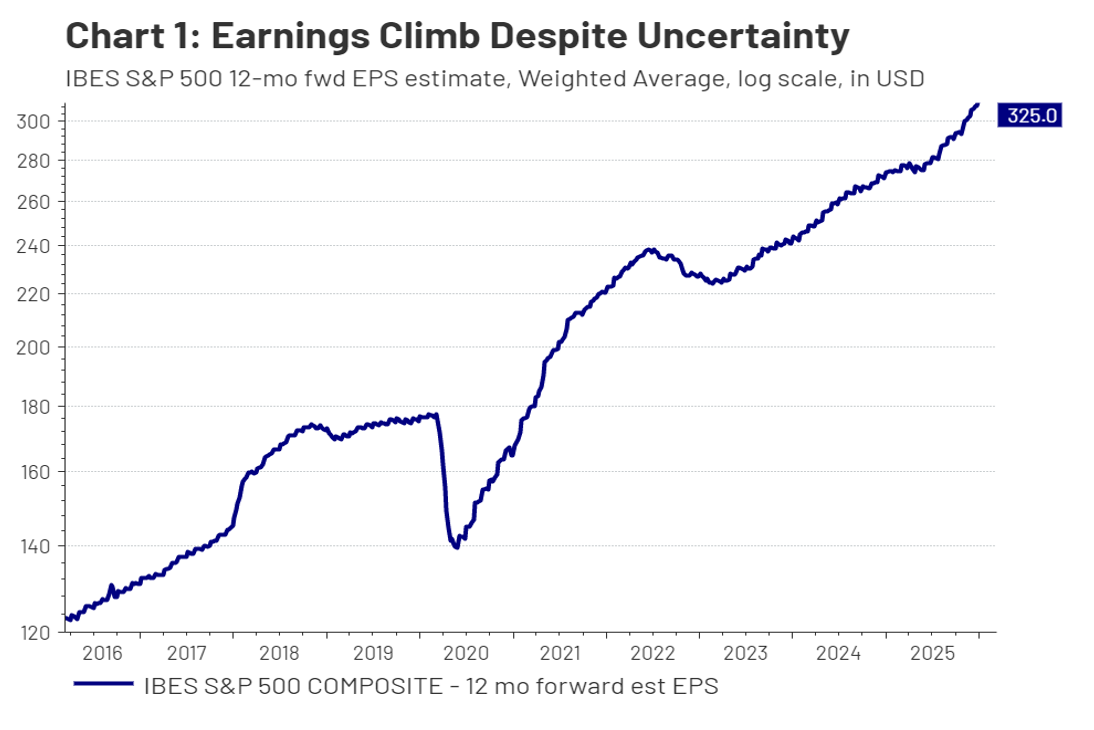
Moving to our second principle, forward earnings expectations for the S&P 500 over the next 12 months have ticked upward in response to these positive surprises (see Chart 1, above). Consistent with our take on sales, analysts continue to see a path for US large-caps to sustain earnings growth.
Our final principle continues to demonstrate the strength of S&P 500 earnings, with both year-over-year earnings and sales growth ticking up to 13.6% and 9.2%, respectively. The Energy sector had negative sales growth due to lower crude oil prices in the fourth quarter of 2025 versus 2024, though positive earnings growth points toward continued efficiency gains in US oil fields. Consumer discretionary’s negative earnings growth was driven primarily by the automobile and homebuilding industries. In our view, both of these shortfalls are largely industry specific, with tariff-driven input costs creating headwinds.
From a thematic standpoint, AI earnings trends remain strong with the technology sector growing 32.5% year-over-year. Also, we are seeing earnings strength in more cyclical-oriented sectors with strong earnings growth in Industrials (34.8%) and materials (24.1%). We believe AI-driven infrastructure build provided a tailwind for these earnings.
Beyond Large-Cap: More Value-Oriented Markets, US Small-Caps, Europe and Japan Take a Step Back

The table above summarizes RiverFront’s view of the earnings picture for four different market segments: US large-cap, small-cap, Europe and Japan. Comparing these segments can help answer our question about value vs growth. US Small-cap, European, and Japanese equities tend to have a greater weighting in more value-oriented sectors, meaning they can provide us insight into whether earnings can provide a catalyst to a value rotation. Additionally, we can compare how each of these markets has changed from last quarter, in order to determine if there is a trend forming. Here is a quick ‘checkup’ for the three non US large-cap market segments:
- US small-cap: Small-cap earnings remained strong based on principle one and two. However, its earnings growth trend turned negative this quarter, with only five sectors having positive growth. One specifically concerning sector is financials, which often represents a bellwether for the broad small-cap market. There are still some sectors that have maintained a positive trend, so there is potential for specific, selection-led investments, though the strength of the large-cap market makes those opportunities less attractive.
- Europe: Last quarter, Europe was the least ‘healthy’ of the four markets we performed a ‘checkup’ on, but it was showing signs of improvement. This improvement has faltered with earnings surprise moving from positive to flat and revenue growth falling from flat to negative. This sales growth (or lack thereof) is particularly concerning given we had hoped the foundation for a value rotation would be elevated, but moderated inflation driving revenues higher.\
- Japan: In the third quarter, we noted an impressive turnaround for Japan that for the most part continued into the fourth quarter, with four of our five indicators remaining positive. The lone exception, earning surprises, was turned negative, though 8 of the 11 sectors had positive surprises. Overall, Japan is relatively ‘healthy,’ though we continue to look for improved consistency between ‘checkups’.
Conclusion: US Large-Cap Remains King; Earnings ‘Checkups’ Have Become Even More Important Moving Forward
The fourth quarter earnings season provided a very strong ‘checkup’ for US large-cap to cap off a very ‘healthy’ earnings year for US large-cap. Each of the three more value-oriented markets we evaluated took a step back from their third quarter ‘checkup’ though, for the most part, all have shown solid progress throughout the year. However, tension in the middle east has created many more pitfalls for global markets moving forward. As such, future earnings analysis as well as market momentum becomes increasingly important in identifying when and where markets are being affected by the fall out of these geopolitical events. We are particularly sensitive to these market signals in our shorter-horizon, lower risk-tolerance portfolios.
Our portfolios are positioned consistently with the takeaways of this analysis. We continue to be overweight US large cap stocks across our balanced portfolios. We have also made selective investments in Europe and Japan, with distinct tilts towards Value and Financials. Moving forward, we will be monitoring corporate surveys, business confidence, earnings guidance and analyst revisions to assess how global markets are navigating the increasingly complex path forward. These more forward-looking and frequent data points can inform us until our next ‘checkup’.
Risk Discussion: All investments in securities, including the strategies discussed above, include a risk of loss of principal (invested amount) and any profits that have not been realized. Markets fluctuate substantially over time, and have experienced increased volatility in recent years due to global and domestic economic events. Performance of any investment is not guaranteed. In a rising interest rate environment, the value of fixed-income securities generally declines. Diversification does not guarantee a profit or protect against a loss. Investments in international and emerging markets securities include exposure to risks such as currency fluctuations, foreign taxes and regulations, and the potential for illiquid markets and political instability. Please see the end of this publication for more disclosures.
Download 03.17.2026 | Weekly View
Authored by
-

Dan Zolet CFA®
Associate Portfolio Manager