
Your choice regarding cookies: We use cookies when you use this Website. These may be 'session' cookies, meaning they delete themselves when you leave the Website, or 'persistent' cookies which do not delete themselves and help us recognize you when you return so we can provide a tailored service. However, you can block our usage by adjusting your browser settings to refuse cookies.

SUMMARY
- Acute geopolitical crises are typically buying opportunities for US stocks.
- North America has favorable oil supply characteristics, lessening economic impact.
- We place high probability of eventual resolution in Iran; however, our risk triggers are on alert for our lower-risk portfolios.
War broke out last week after the US and Israel launched strikes killing Iran's leadership and targeting its command, missile, and nuclear sites. Iran has retaliated and is attempting to close the Strait of Hormuz, spiking oil well above ~$100 and roiling global markets. In emotional times like these, an investor's greatest challenge is keeping perspective — seeing the forest through the trees. For us, that means remembering two important facts:
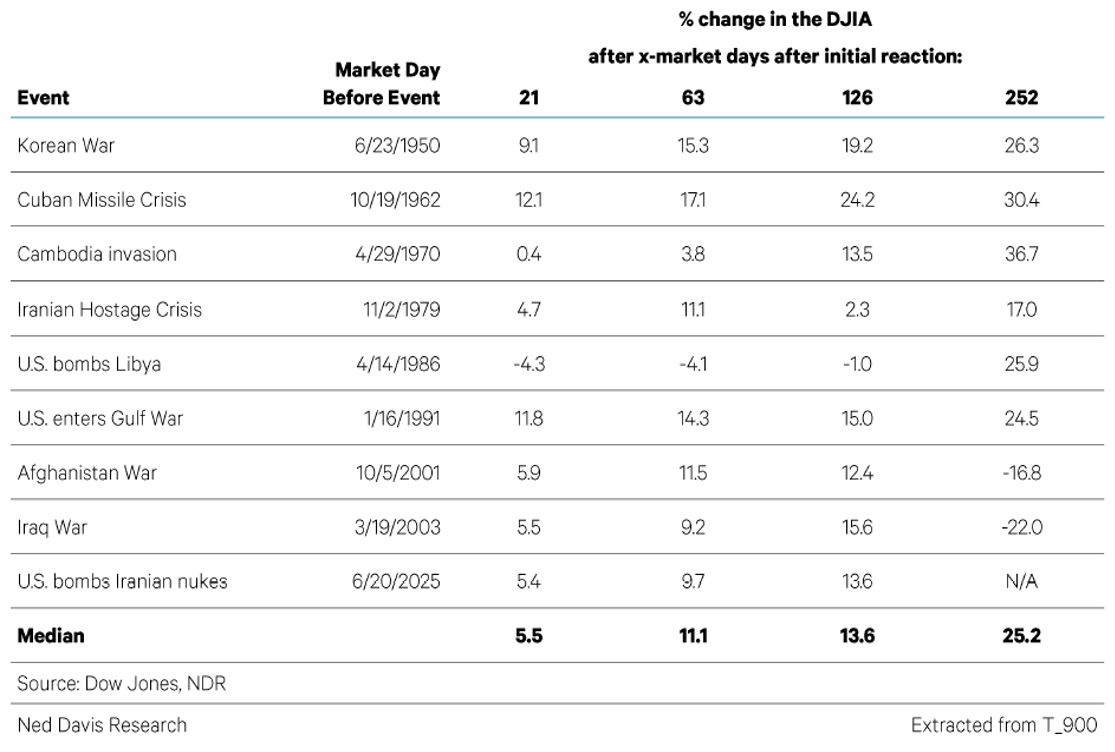
Acute geopolitical crises have largely been buying opportunities. NDR Research data shows that in 9 separate events from the Cuban Missile Crisis to the Gulf War to Iraq in '03, stocks were generally followed by higher markets over the next 3, 6, and 12 months (see Table, page 3 for details…or our previous commentary found here).
Oil is well supplied in North America, limiting US economic impact. Asian and European equity and FX markets have been hit significantly harder than US stocks — reflecting America's energy independence, as we’ve written about here. Nonetheless, this remains fluid and humility is key. Our investment team finds scenario analysis helpful in framing our thinking.
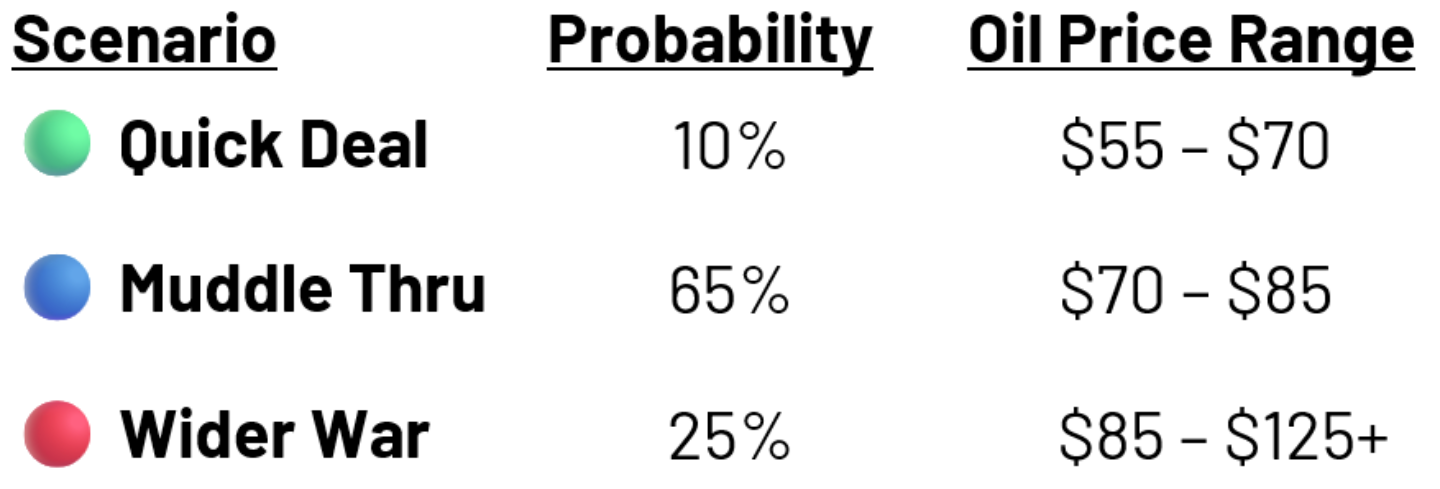
🟢‘QUICK CEASEFIRE/DEAL’: Less Likely (10% probability)
- Definition: Short duration war, opening of Strait of Hormuz, no OPEC production loss, regime change friendly to US and accepted by Iranian people
- Eventual Oil Range: $55-70
- Inflation: Lower
- Fed Action: >2 cuts in ‘26
- Favored Assets: International, US Tech, longer-duration fixed income
🔵‘MUDDLE THRU’: More Than Likely (65% probability)
- Definition: 100-120 day duration air war; largely contained to Iran
- Eventual Oil Range: $70-85
- Inflation: Stable, after initial spike
- Fed Action: At least 1 cut in ‘26
- Favored Assets: US stocks, cyclicals, covered calls
🔴‘WIDER WAR’:Unlikely, but Taking It Seriously (25% probability)
- Definition: Strait of Hormuz remains effectively closed, other Middle Eastern countries joining the fray, US ground troop commitment, conflict goes global (China or Russia commit to supporting Iran)
- Eventual Oil Range: $85-125+
- Inflation: Significantly higher
- Fed action: No cuts in ‘26; possible hike in ‘27
- Favored Assets: Cash and T-bills, commodity-related instruments, covered calls
CHART: S&P 500 Pullback Still Fairly Orderly; Significant Violation Of 6500 Would Be Negative Signal
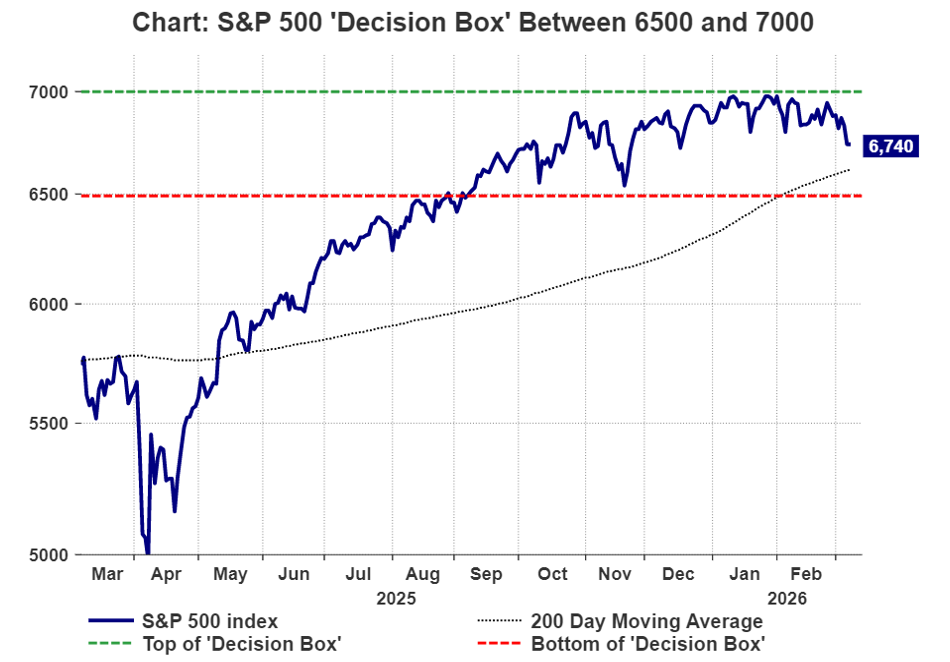
We remain constructive on US and global equities, seeing limited risk of a recession and a protracted bear market. Back-to-back manufacturing PMI survey expansions and solid Q4 earnings results with strong revisions all support this view.
Three geopolitical scenarios could shift us more cautious: an Arab state attacking Iran, coordinated Iran-linked attacks on Western soil, or Russian and/or Chinese military intervention on Iran's behalf. Recent volatility, while unsettling, is consistent with midterm years and Fed Chair transition periods — though a prolonged oil spike would complicate matters for incoming Chair Kevin Warsh.
CONCLUSION: Risk Management on Alert; Watching ‘Decision Box’ Closely
Our technical risk processes are on alert, particularly for shorter-horizon balanced portfolios (5–7 year horizons and under), which tend to adhere to a tighter moving-stop discipline. Note that elevated volatility makes the timing of any portfolio moves challenging and keeps our philosophy of humility and intellectual flexibility top of mind.
In the chart above we suggest there is a ‘decision box’ as investors weigh up the various scenarios. In a ‘Muddle Through’ scenario, we think the S&P 500 will remain within this ‘box’ between roughly 6500-7000. A ‘Quick Ceasefire’ could see a break to new highs, but in the ‘Wider War’ scenario, stocks could well break down through the bottom of the box. Key near-term support levels are the 200-day Moving Average at 6616 and the 23% retracement of the April 7th low at 6,490, where we have drawn the bottom of the box. A breach of the latter could potentially trigger a more significant equity/fixed income reallocation in our lower-risk balanced portfolios.
Risk Discussion: All investments in securities, including the strategies discussed above, include a risk of loss of principal (invested amount) and any profits that have not been realized. Markets fluctuate substantially over time, and have experienced increased volatility in recent years due to global and domestic economic events. Performance of any investment is not guaranteed. In a rising interest rate environment, the value of fixed-income securities generally declines. Diversification does not guarantee a profit or protect against a loss. Investments in international and emerging markets securities include exposure to risks such as currency fluctuations, foreign taxes and regulations, and the potential for illiquid markets and political instability. Please see the end of this publication for more disclosures.
APPENDIX - TABLE 1: ACUTE GEOPOLITICAL CRISES HISTORICALLY BUYING OPPORTUNTIES FOR US STOCKS
Download 03.09.2026 | Weekly View
Authored by
-

Chris Konstantinos CFA®
Managing Partner | Chief Investment Strategist