
Your choice regarding cookies: We use cookies when you use this Website. These may be 'session' cookies, meaning they delete themselves when you leave the Website, or 'persistent' cookies which do not delete themselves and help us recognize you when you return so we can provide a tailored service. However, you can block our usage by adjusting your browser settings to refuse cookies.

SUMMARY
- Rate moves on hold, as labor market stabilizes and the upside risk to inflation has diminished.
- Leadership transition faces obstacles due to DOJ subpoenas.
- We believe the Fed will overcome challenges and maintain its credibility.
The Federal Reserve (Fed) was established in 1913 to be the lender of last resort to the banking system. While the Fed’s original purpose still exists, it no longer has that singular focus. The Fed has had to adapt its role to fit the monetary landscape over the years, and it does not appear that 2026 will be any different. The Fed faces a number of challenges this year, including calibrating the appropriate policy rate, transitioning leadership, fighting a Department of Justice (DOJ) subpoena, and maintaining its independence. We believe that the Fed can overcome most, if not all these challenges whether or not they get cooperation from the executive, legislative, and judicial branches of the government.
Fed On Hold as Labor Stabilizes and Inflation Risk Diminished
The Federal Reserve Reform Act of 1977 set forth the Fed’s dual mandate of ‘full employment’ and ‘price stability’. Last week, the Federal Open Market Committee (FOMC) met to set the appropriate interest rate policy to achieve its dual mandate. While the FOMC left the Fed funds rate unchanged at its January 28th meeting, committee members were not in complete agreement. Like the FOMC meeting in December, there were dissenting members that felt that the rate should be lower, calling for a 25-basis point cut. However, the vote was 10 to 2 in favor of holding rates steady, after cutting a total of 75 basis points over the prior 3 meetings. Fed officials pointed to stabilization of the unemployment rate as well as solid economic growth as reasons for holding interest rates steady. Chairman Powell stated that the Fed was appropriately positioned to manage the dual mandate, as the upside risks to inflation and the downside risks to labor have diminished.
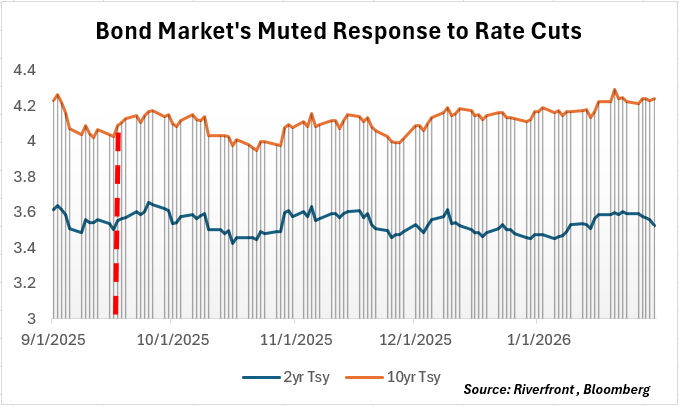
Currently, the target fed funds range is 3.50% to 3.75%, with the effective fed funds rate falling roughly in the middle of this range at 3.64%. However, despite the FOMC reducing rates since last September, the bond market has not reacted in a manner that would make a dramatic difference in the lives of consumers. For example, the chart above shows that the 10-year Treasury yield (orange line) is higher now than it was when the FOMC made the first 25-basis point cut on September 17th (the dotted red line), thus keeping mortgage rates above the 6% mark. Even shorter maturity Treasuries like the 2-year are virtually unchanged over the period as well. This begs the question: why have yields not reacted more to Fed cuts? The short answer, as we explore in more detail below, is that the bond market does not believe inflation will moderate to the Fed’s 2% target anytime soon. We agree and remain underweight fixed income across our balanced portfolios as a result. The questions left on the minds of investors are: what data matters to the Fed, and what will it take to make it cut rates further?
We believe for the Fed to make additional cuts under a Powell-led FOMC, labor market deterioration would have to resume with the unemployment rising back up to 4.6% or higher from its current 4.4% level. Additionally, inflation would have to move closer towards the Fed’s 2% percent target.
Chairman Powell made the argument during his post meeting press conference that inflation is running just above 2% ex-tariffs. However, if this were truly the case, the bond market would reward investors with lower yields at the front-end of the yield curve represented by the 2-year Treasury, in our opinion, Chairman Powell insinuated that the embedded costs of tariffs are “transitory,” because economists calculate inflation on a year-over year basis. Hence, why members of the FOMC were willing to pre-emptively cut rates last year while its preferred gauge of inflation remained elevated at 2.8%. However, from consumers’ perspective, inflation is judged by the absolute dollar cost today versus the cost previously. For the time being, the bond market is voting with the consumer and not policymakers.
Fed Leadership Transition Sitting on a Tectonic Plate
Another challenge for the Fed is the upcoming leadership transition. Chairman Powell’s term as Fed Chairman is scheduled to end in May, and President Trump just announced Kevin Warsh as his successor on January 30th. According to reports, President Trump had narrowed his choices down to four candidates but chose a former Fed governor instead of picking an outsider. Under normal circumstances the transition would be routine, but this year it takes on a greater importance due to President Trump’s public disapproval of the Fed’s current monetary policy and the level of interest rates. Hence, the President sought to appoint a chairman that will be deemed credible to the financial community, while aligning with his thinking that interest rates need to be lower. The concern from market participants is that the next chairman will be beholden to the Trump administration’s wishes, lowering interest rates for political reasons rather than for the purpose of upholding the Fed’s dual mandate – a concern we discussed in the July 29, 2025 Weekly View.
Further complicating the leadership transition is the DOJ’s subpoenas to Chairman Powell regarding his congressional testimony on renovation cost overruns at two Fed buildings. This act was seen by some Democrats and Republicans in Washington as an escalation of political pressure that threatens the Fed’s independence. Republican Senator Thom Tillis has vowed to block all Fed nominations until there is resolution of the DOJ investigation. Technically, Powell could upset the apple cart further by deciding to serve out his full term as a Fed Governor, which expires in 2028 after his chairmanship ends. Not only would this be rare, but it would put additional pressure on his successor as chair to uphold monetary policy independence. We only give this outcome a 10% probability of occurring given that Powell believes in the traditions, culture, and collegiality of the Fed. We believe Powell will cede the spotlight to Kevin Warsh, if he is confirmed by the Senate, and make a graceful exit from the central bank.
Conclusion: We Expect Fed to Maintain Credibility; Remain Constructive on Stocks, Underweight Fixed Income
The Fed has done enough to maintain a solid economy, in our view, and now it must pause to see if the economic data supports its current monetary policy. As for the political and leadership headwinds, we believe the best-case scenario for markets would be the DOJ drops the investigation, the Senate confirms the new chair, and the President backs away from the public assault on the Fed, leaving Powell to stick with tradition and exit the central bank. This is the cooperation we alluded to earlier between the three branches of the government that could lower volatility in both the stock and bond markets and reinforce the Fed’s credibility, in our opinion.
However, even if the President continues to try and pressure the Fed into rate cuts, we believe FOMC members will respect the sanctity of the central bank’s independence and the creditability that it affords their decision-making process, regardless of their political affiliation. For this reason, if the Trump Administration nominates a chair-in-waiting to try to sway the thinking of members, there is no guarantee that their votes will subsequently align with the President’s wishes.
Also, as we discussed last week, we view Trump as a pragmatist who (eventually) is sensitive to market feedback. Investors view the Fed as an independent entity, and when the Fed’s status is perceived differently, bond buyers tend to push yields higher. Should the bond market become concerned regarding the level of rates, it will push rates up, increasing interest expense for government debt and pressuring the economy. We believe that this runs contrary to the Trump Administration’s aims, and they would likely find a politically palatable way to back off Fed pressure if it were perceived as a hinderance to yields falling and the economy expanding.
From a portfolio positioning perspective, we believe the Fed’s pre-emptive rate cutting has been fully priced into financial markets. Therefore, we are focused on the earnings growth potential a healthy economy affords companies. For this reason, we continue to tilt the portfolios towards sectors and industries such as technology, financials, and industrials that generate significant free cashflow. Currently, we prefer stocks over bonds, as the bond market is signaling that further rate cuts are not warranted.
Risk Discussion: All investments in securities, including the strategies discussed above, include a risk of loss of principal (invested amount) and any profits that have not been realized. Markets fluctuate substantially over time and have experienced increased volatility in recent years due to global and domestic economic events. Performance of any investment is not guaranteed. In a rising interest rate environment, the value of fixed-income securities generally declines. Diversification does not guarantee a profit or protect against a loss. Investments in international and emerging markets securities include exposure to risks such as currency fluctuations, foreign taxes and regulations, and the potential for illiquid markets and political instability. Please see the end of this publication for more disclosures.
Download 02.03.2026 | Weekly View
Authored by
-

Kevin Nicholson CFA®
Global Fixed Income CIO | Partner